
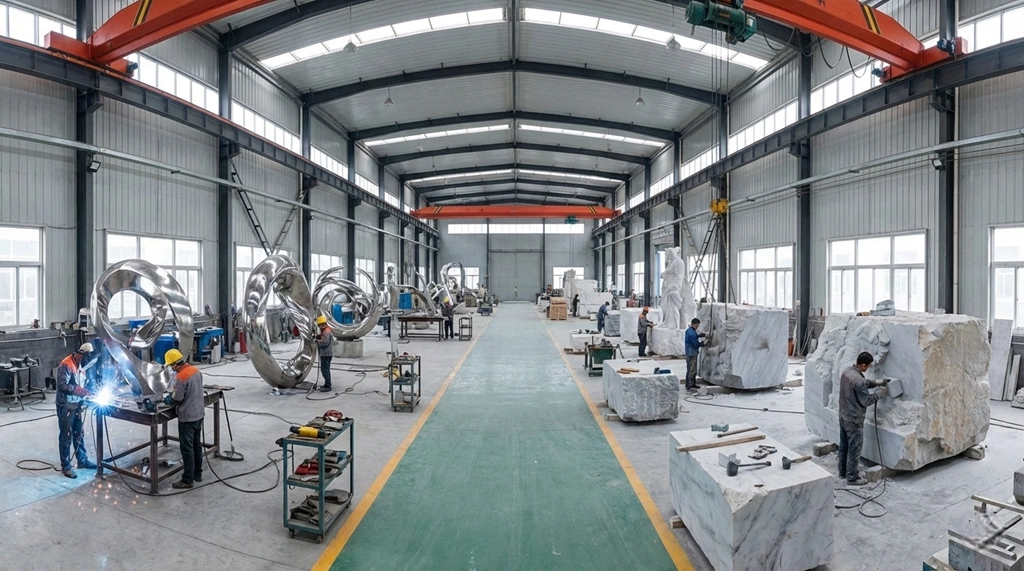
China is home to the world’s most concentrated cluster of skilled sculpture workshops, foundries, and fabrication facilities — a manufacturing ecosystem that has produced fine art and architectural sculpture for clients on every continent. Yet navigating this ecosystem as a first-time international buyer is genuinely challenging. Communication barriers, quality inconsistency across workshops, and the difficulty of verifying claims from abroad create real risks for buyers who approach the market unprepared.
This guide is designed for B2B buyers — landscape architects, hotel developers, municipal procurement officers, art consultants, and distributors — who are evaluating sculpture manufacturers in China. We cover the evaluation criteria that matter, the verification methods that work, and the red flags that indicate a workshop is not a credible long-term partner.
Why China Dominates Custom Sculpture Manufacturing
China’s position as the world’s leading custom sculpture manufacturer rests on three reinforcing advantages: a deep craft tradition concentrated in specific geographic regions, a training infrastructure that produces skilled artisans at scale, and a materials supply chain that provides access to the world’s finest stone and metal stocks at competitive prices.
The Quyang Cluster: A 2,000-Year Craft Ecosystem
The city of Quyang, in Hebei Province, is the center of China’s marble and granite sculpture industry. Carving traditions in Quyang date to the Tang Dynasty (618-907 CE), and the city’s workshops have produced stone sculpture for architectural and memorial projects worldwide. The concentration of skilled carvers, specialized tooling suppliers, material brokers, and logistics companies in Quyang creates an ecosystem that cannot be easily replicated elsewhere — which is why even European sculpture studios source carved elements from Quyang workshops.
Skilled Labor Availability
China’s sculpture workshops employ carvers who have typically trained for 8-15 years in their discipline — stone carvers begin their training in their late teens and reach journeyman capability by their late twenties. This training pipeline is sustained by a cultural tradition that values craftsmanship and by the economic incentive of a wage premium for skilled carving work.
The 7 Key Criteria for Evaluating a China Sculpture Manufacturer
Criterion 1: Physical Workshop Verification
Before placing any significant order, verify that the manufacturer has a physical workshop. Request a video call that walks through the workshop — not a pre-recorded promotional tour, but a live walk-through where the supplier’s representative shows you the actual carving benches, stone storage, finishing areas, and dispatch area. A credible manufacturer will welcome this request.
Ask to see the specific type of work your project requires: if you need bronze casting, request a walk through the foundry; if you need marble carving, walk the carving benches. Some workshops specialize in one material and subcontract others — knowing this before you order prevents quality mismatches.
Criterion 2: Years in Business and Export Experience
The sculpture industry in China rewards longevity. Workshops that have survived 20+ years of competition have done so by maintaining quality standards that generate repeat business and referrals. Ask directly how long the workshop has been operating and what percentage of their work is for international clients.
Export experience matters as much as workshop age. A workshop that has exported to North American and European markets understands the packaging, documentation, and quality expectations of those markets. Ask for examples of projects in your target region.
Criterion 3: Portfolio Quality and Relevant Experience
Review the manufacturer’s portfolio critically. Look specifically for: projects of similar scale to your commission, projects in the same material you require, projects in comparable stylistic categories, and projects in your target market. A workshop with a strong portfolio of garden ornaments may not have the engineering capability for monumental work.
Ask for references from clients in your market. A manufacturer who has completed satisfactory projects for clients in North America, Europe, or Australia has navigated the quality expectations and communication requirements of those markets.
Criterion 4: Material Testing and Certification
For stone sculptures, ask for material test certificates from an accredited testing laboratory. For marble, the key specifications are: compressive strength (minimum 150 MPa for outdoor structural work), water absorption (below 0.6% for outdoor applications), and flexural strength (above 15 MPa). For bronze, ask for alloy certification confirming the specific alloy composition (CuSi8P for standard silicon bronze, or as specified).
A manufacturer who cannot provide material test certificates for a significant commission is either cutting corners or working with a material supplier who cannot certify their product.
Criterion 5: Engineering and Structural Design Capability
For sculptures above 1.5 meters in any dimension, structural engineering is not optional — it is a safety and longevity requirement. Ask whether the manufacturer has an in-house structural engineer or works with external engineering consultants. Request sample structural drawings for previous monumental commissions.
For marble and bronze sculptures in active poses (galloping horses, leaping figures, birds in flight), the internal armature design is the critical engineering component. A workshop that does not understand cantilever stress in stone or bronze should not be commissioned for complex posed sculptures of significant scale.
Criterion 6: Communication Quality and Project Management
Evaluate communication quality during the inquiry phase. A manufacturer who responds promptly, answers specific questions thoroughly, and proactively raises issues they foresee with your design is demonstrating project management capability that will matter throughout the commission.
Ask about their project management process: Who is the point of contact during production? How are progress updates communicated? How are quality issues identified and escalated? What is the revision policy if the client requests changes during fabrication? The answers to these questions reveal operational maturity.
Criterion 7: Export Logistics and Documentation Capability
Ask about their export process: Do they handle export documentation including commercial invoice, packing list, and Certificate of Origin? Do they work with freight forwarders experienced in stone and sculpture shipping? Do they provide crate specifications (closed crate vs. open crate, internal cushioning) that meet international standards for art and antique shipping?
A manufacturer who has a dedicated export coordinator — not just a salesperson who handles occasional international orders — will manage the logistics of your project with significantly less friction.
Red Flags: Warning Signs of an Unreliable Manufacturer
Cannot Provide a Video Walk-Through
If a supplier cannot arrange a live video walk-through of their workshop within a reasonable timeframe (1-2 weeks), this is a significant concern. It may indicate that they are a trading company representing multiple workshops rather than a workshop with direct production capability — or that their workshop does not contain the equipment or workforce they claim.
Prices Significantly Below Market Rate
The sculpture market is reasonably transparent about pricing. If a quotation comes in more than 30% below comparable competitive quotes from established manufacturers, either the quality will be significantly below comparable (and you are comparing apples to oranges), or the supplier is underpricing to win the order and will recover their margin through quality reductions during production.
No Sample Policy for Significant Commissions
For commissions above USD 10,000, a reputable manufacturer should be willing to produce a sample element — a carved panel, a small casting, or a scale model — that demonstrates their quality before full production commences. A refusal to provide samples (or a policy that only allows sample production at full price with no credit against the order) is a warning sign.
Vague Answers to Specific Questions
If you ask specific questions — alloy specification, compressive strength data, structural engineering drawings — and receive vague answers or deflected responses, this indicates that the manufacturer either lacks the technical capability to address these issues or is unwilling to have their claims scrutinized. Specific questions deserve specific answers.
No Export References
A workshop that has no export references — no completed projects in North America, Europe, or comparable markets — has not demonstrated that they can navigate the quality expectations, documentation requirements, and logistics of international shipping. This is not disqualifying for a first order, but it should be factored into your risk assessment and your project management approach.
The Factory Visit Checklist: What to Inspect In Person
If you are planning a factory visit — and we recommend visiting any manufacturer before placing an order above USD 50,000 — use this checklist to structure your inspection.
- Stone and material storage: Is material stored under cover? Is it organized by material type and quality grade?
- Carving benches: Are they actively staffed? What is the average experience level of the carvers?
- Equipment: What cutting, carving, and finishing equipment is available on-site?
- Quality control: Is there a dedicated quality inspection process before dispatch? Who performs it?
- Finishing area: Is there a dedicated polishing and patina application area? What are the safety protocols?
- Packing area: Are crates built on-site or sourced externally? What is the packing specification for international shipment?
- Management: Who will manage your project? How many other projects do they manage simultaneously?
- Showroom: Is there a finished work display area? Can you examine recent pieces at close range?
How Long Does It Take to Manufacture a Custom Sculpture in China?
Production timelines vary significantly by material, scale, complexity, and workshop scheduling at the time of order placement.
Marble Sculptures
Custom marble sculptures in standard sizes (under 2 meters, existing design modifications) require 8-12 weeks from design approval. Life-size and monumental marble sculptures require 12-24 weeks. Fully custom designs requiring original concept development add 4-8 weeks to the schedule.
Bronze Sculptures
The lost-wax bronze casting process requires more time than stone carving: 12-20 weeks for standard life-size figures and animals; 16-28 weeks for complex monumental commissions. Rush fabrication is available at a premium of 25-50% from most foundries.
Stainless Steel Sculptures
Custom stainless steel sculptures in standard sizes require 8-14 weeks from design approval. Complex monumental commissions with significant engineering requirements can require 20-36 weeks including engineering review and structural testing.
Payment Terms: What Is Standard for International Sculpture Orders?
The standard payment structure for custom sculpture commissions from China is: 40% deposit to commence fabrication, 60% balance prior to shipment. This structure protects both parties — the deposit covers the manufacturer’s material and labor costs in the event of a client default, while the balance payment ensures the client does not pay in full before the work is complete and inspected.
For orders above USD 50,000, many established manufacturers accept Letters of Credit (L/C at sight) issued by a recognized international bank. L/C payment provides the buyer with the security of knowing that payment is contingent on presentation of shipping documents confirming the order has been shipped.
Beware of manufacturers who request 100% payment upfront — this transfers all execution risk to the buyer without any contractual safeguard. A reasonable deposit (40-50%) is standard; full payment upfront is not.
Frequently Asked Questions
What is the typical cost of commissioning a sculpture from China?
Commissioning costs vary enormously by material, scale, complexity, and finish specification. As rough benchmarks: a small marble fountain (under 1m) typically ranges USD 5,000-15,000; a life-size marble figure USD 25,000-60,000; a life-size bronze figure USD 35,000-90,000; a monumental stainless steel sculpture (above 5m) USD 80,000-500,000+. These are CIF (Cost, Insurance, Freight) price estimates for the sculpture delivered to your port — installation, foundation, and duties are additional.
Can I trust the quality from a China workshop?
Yes — with appropriate supplier selection. China produces some of the world’s finest sculpture, and the same workshops that produce for European museum clients produce work for international markets. The key variables are: selecting a workshop with proven international references, specifying appropriate quality standards in the contract, and establishing appropriate quality verification processes during production.
How do I verify quality before shipment?
For commissions above USD 15,000, we recommend requesting a pre-shipment inspection by an independent third-party inspection service (companies such as QIMA, Bureau Veritas, and SGS offer sculpture and stone product inspection services). The inspector verifies dimensional accuracy, surface finish quality, packaging adequacy, and documentation completeness against the agreed specification. A pre-shipment inspection costs approximately USD 200-400 and is money very well spent on significant commissions.
What happens if the sculpture arrives damaged?
Any international shipment should be insured for the full declared value. We arrange marine and transit insurance for all our shipments through established insurance providers, with coverage for damage during loading, sea freight, unloading, and transportation to the final destination. Damage claims are processed through the insurance claim procedure with photographic documentation. We have a claim resolution rate of 98% for minor damage and 100% for major damage in our shipping history.
Do you offer installation services?
We provide comprehensive installation documentation including foundation drawings, rigging plans, assembly procedures, and commissioning checklists. We can arrange supervised installation through our network of stone and bronze installation specialists in North America, Europe, the Middle East, and Southeast Asia. Installation costs are quoted separately and typically range from 15-25% of the sculpture CIF value depending on site complexity and location.
What is your warranty policy?
We provide a 10-year structural warranty covering casting defects, material defects, and armature failure for all sculptures. The warranty does not cover damage from improper installation, inadequate maintenance, or environmental conditions outside the material’s specified operating range. Full warranty terms are provided with the project proposal.
Why B2B Buyers Choose Shushin Art
Shushin Art has operated in Quyang since 1974, producing sculpture for international clients for over 35 years. We maintain a fully integrated production facility — stone carving workshop, bronze foundry, stainless steel fabrication division, finishing and packing facility — on a single site in Quyang, giving us direct control over every phase of production.
Our international client base includes landscape architecture firms, hotel development groups, municipal governments, art consultants, and museum curators on six continents. We maintain dedicated English-speaking project managers for international clients, with a commitment to response within 24 hours on all project communications.
We welcome factory visits by appointment, video walk-throughs for clients who cannot travel, and third-party pre-shipment inspections on all significant commissions.
Related Resources
- Factory Tour — Live video tour of our Quyang production facility
- Custom Marble Sculptures — Our marble fabrication capabilities
- Custom Bronze Sculptures — Our lost-wax bronze foundry capabilities
- Custom Stainless Steel Sculptures — Our steel fabrication and engineering capabilities
- About Shushin Art — Our history, certifications, and international client references
- Contact Our Team — Submit your project inquiry for a detailed proposal