
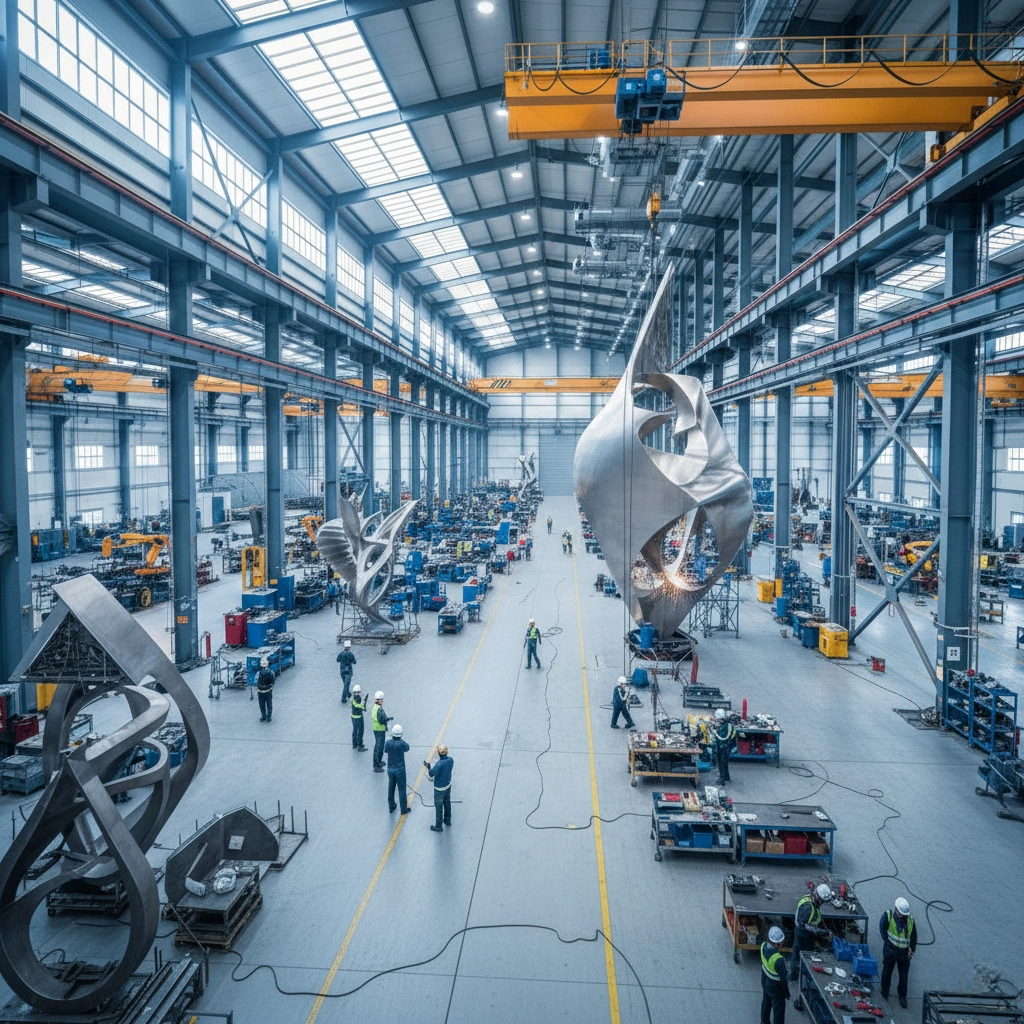
In the rapidly evolving urban landscapes of 2026, a large-scale outdoor sculpture is far more than a decorative element—it is a statement of permanence, a landmark of cultural identity, and a testament to engineering excellence. For architects, urban developers, public art consultants, and landscape designers, the success of any monumental installation hinges on achieving the delicate balance between artistic vision and structural integrity.
At Shushin Art, our 50-year heritage in Quyang—the acknowledged sculpture capital of China and the world—has taught us a fundamental truth: grandeur is built upon a foundation of precision engineering. This comprehensive technical guide explores the methodologies, standards, and innovative processes required to create world-class outdoor metal sculptures that stand the test of time while capturing the imagination of generations.
Why Engineering Matters in Sculpture Fabrication
Too often, commissioning clients focus exclusively on aesthetic considerations—the shape, the surface finish, the symbolic meaning—while underestimating the critical importance of structural engineering. Yet a sculpture that fails structurally represents not just a financial loss, but a potential safety hazard and a permanent blemish on the artist’s and fabricator’s reputation.
Large-scale outdoor sculptures face unique challenges that indoor artworks never encounter:
- Wind Loads: A 10-meter sculpture can experience forces of several tons during severe storms
- Thermal Expansion: Metal expands and contracts with temperature changes, requiring careful engineering of joints and connections
- Corrosion: Outdoor exposure to rain, humidity, salt air, and industrial pollutants demands material selection that prevents degradation
- Seismic Activity: In earthquake-prone regions, sculptures must be designed to remain stable during ground movement
- Vandalism and Impact: Public art must withstand accidental impacts and deliberate misuse
At Shushin Art, we integrate engineering from the earliest stages of design, ensuring that beauty and structural soundness are inseparable aspects of every commission.
Material Selection: The Science of Stainless Steel Alloys
The foundation of any successful outdoor metal sculpture project begins with material selection. Not all stainless steel is created equal, and the choice between different alloys has profound implications for longevity, maintenance requirements, and long-term cost of ownership.
Type 304 Stainless Steel: The Standard Commercial Alloy
Type 304 is the most widely used stainless steel grade, accounting for approximately 50% of global production. It offers:
- Excellent corrosion resistance for general indoor and sheltered outdoor applications
- Good formability and weldability
- Cost-effectiveness for budget-sensitive projects
- Suitability for mild climate environments
Limitations: In coastal environments, areas with heavy industrial pollution, or regions with frequent freeze-thaw cycles, 304 may develop “tea staining” (brown discoloration) and surface pitting within 5-10 years without maintenance.
Type 316L Marine-Grade Stainless Steel: The Premium Choice for Outdoor Art
For all Shushin Art outdoor commissions, we exclusively recommend Type 316L—the “marine-grade” stainless steel. The critical difference lies in its chemical composition:
- Molybdenum Content (2-3%): This is the key differentiator. Molybdenum dramatically improves resistance to pitting and crevice corrosion in chloride-rich environments.
- Low Carbon Content (L): The “L” designation means carbon content below 0.03%, minimizing carbide precipitation during welding and preserving corrosion resistance in heat-affected zones.
- Superior Durability: Maintains structural integrity and appearance for 50+ years even in harsh coastal or industrial environments.
While 316L costs 20-30% more than 304, this premium investment eliminates:
- The risk of unsightly surface degradation
- Expensive restoration treatments
- Premature replacement of failed components
- Reputational damage from visible deterioration
The Artistic Blueprint: Bridging Digital Design and Physical Reality
The transformation of an artistic concept into a physical reality requires a carefully orchestrated journey through multiple design phases. At Shushin Art, we have developed a proven methodology that honors both the creative vision and the engineering requirements.
Phase 1: Concept Development and Digital Modeling
Every major commission begins with detailed discussions to understand:
- The client’s artistic vision and aesthetic preferences
- Installation site characteristics and environmental conditions
- Budget parameters and timeline requirements
- Structural constraints and engineering considerations
Our design team creates photorealistic 3D renders that allow clients to visualize the completed sculpture in its intended environment. These digital models serve as the foundation for engineering analysis and client approval.
Phase 2: Physical Prototyping — The Value of Clay Models
While digital tools are essential, they cannot fully capture the tactile reality of monumental scale. This is why we maintain the traditional practice of creating 1:1 scale clay models for major commissions.
The clay model allows:
- Real-world proportion verification at actual scale
- Identification of visual weight imbalances invisible in digital renderings
- Client and stakeholder approval of the physical form before committing to metal fabrication
- Fine adjustments to organic curves and surfaces
Once the clay model is perfected, we utilize high-resolution 3D scanning to create a precise digital template that guides the metal fabrication process.
Structural Engineering: The Invisible Architecture
The internal armature—the hidden structural skeleton that supports the outer skin of a sculpture—is arguably the most critical engineering element. It must be invisible yet invincible.
Engineering Principles for Monumental Scale
For sculptures exceeding 3 meters (10 feet) in height, we employ advanced engineering methodologies:
- Finite Element Analysis (FEA): Computer modeling to simulate stress distribution under various loading conditions
- Wind Load Calculation: Determinination of structural requirements based on local wind speed data and sculpture geometry
- Foundation Design: Coordination with structural engineers for pile, pad, or anchor specifications
- Modular Construction Planning: Division of large sculptures into shippable sections while maintaining structural unity
Internal Armature Materials and Construction
Our internal skeletons are engineered using:
- 304 Stainless Steel Tubing: For the primary structural framework, providing excellent strength-to-weight ratio
- Hot-Dip Galvanized Steel: For secondary support structures, with zinc coating providing 50+ years of corrosion protection
- Anti-Corrosion Primers: Industrial-grade coatings applied to all steel surfaces before assembly
- TIG Welding: Tungsten Inert Gas welding creates precise, strong joints with minimal heat distortion
The goal is to create a unified structural unit where every welded joint is as strong as—or stronger than—the base material itself.
The Fabrication Process: From Metal to Masterpiece
Step 1: Metal Forming and Shaping
Large-scale stainless steel sculptures are typically created using a combination of techniques:
- CNC Plasma/Laser Cutting: Precision cutting of flat sheets to create pattern pieces
- Hydraulic Press Braking: Forming curved surfaces on sheet metal
- Manual Hammering and Planishing: Skilled craftsmen refine organic shapes by hand
- TIG Welding: Joining individual pieces into seamless continuous surfaces
Step 2: Surface Preparation
Before applying the final finish, all surfaces undergo rigorous preparation:
- Removal of mill scale and surface oxidation
- Grinding of weld seams to match surrounding surfaces
- Progressive sanding through increasingly fine grits (typically 80 to 320 grit)
- Inspection under controlled lighting to identify imperfections
Step 3: Surface Finishing
The final surface treatment defines the sculpture’s visual identity:
- Mirror Polish: Up to 600 hours of progressive sanding and hand-buffing to achieve distortion-free reflections
- Brushed/Satin Finish: Uniform directional texture using fine abrasives
- PVD Color Coating: Titanium nitride and other coatings for gold, rose gold, or black finishes
Quality Assurance: Our Multi-Stage Inspection Protocol
Every Shushin Art sculpture undergoes comprehensive quality inspection at each production stage:
- Material Verification: Mill certifications and PMI (Positive Material Identification) testing
- Weld Quality Inspection: Visual and dye penetrant testing of all structural welds
- Surface Quality Check: Final finish inspection under standardized lighting conditions
- Factory Pre-Assembly: Complete assembly at our facility to verify fit and alignment before shipping
- Pre-Shipment Photography: Detailed documentation of the sculpture’s condition before crating
Global Logistics: Delivering Masterpieces Worldwide
Shipping a 10-ton sculpture across oceans requires meticulous planning and professional logistics coordination:
Modular Construction Strategy
Large sculptures are designed for disassembly into numbered sections that:
- Fit within standard shipping container or flat-rack dimensions
- Can be reassembled using pre-drilled alignment holes
- Maintain structural integrity across modular joints
- Allow for on-site adjustment if site conditions differ slightly from specifications
Museum-Grade Export Crating
All international shipments utilize heavy-gauge steel-framed wooden crates with:
- Custom-cut foam inserts cradling each sculpture section
- Desiccant packets to control humidity during ocean transit
- GPS tracking devices for valuable shipments
- Full-value marine insurance coverage
Installation: The Final Transformation
Our commitment extends beyond fabrication. We provide comprehensive installation support including:
- Detailed foundation drawings and specifications
- On-site installation supervision (quoted separately)
- Crane and rigging coordination guidance
- Final leveling and adjustment procedures
- Documentation for ongoing maintenance
Frequently Asked Questions
What is the typical lead time for a large-scale sculpture project?
For sculptures exceeding 5 meters, the typical timeline ranges from 12 to 24 weeks:
- Design finalization and approval: 2-4 weeks
- Clay modeling and 3D scanning: 3-5 weeks
- Internal armature fabrication: 4-6 weeks
- Outer skin forging and welding: 6-10 weeks
- Surface preparation and finishing: 3-5 weeks
- Factory pre-assembly and quality inspection: 1-2 weeks
- Export crating and logistics preparation: 1-2 weeks
How is a monumental sculpture shipped and installed?
We utilize a modular construction approach where the sculpture is built in numbered sections at our factory. Each module undergoes pre-assembly testing to ensure perfect fit. Sections are then packed in custom steel-reinforced crates and shipped via sea freight to the destination port. We provide:
- Detailed foundation drawings with anchor specifications
- Crane and rigging requirements documentation
- On-site installation supervision (optional, quoted separately)
- Final assembly and leveling procedures
What engineering standards do your sculptures meet?
Our standard structural engineering specifications include:
- Wind load resistance up to Category 3 hurricane conditions (120 mph / 193 km/h)
- Seismic Zone 4 compliance for standard configurations
- 50-year design lifespan for 316L stainless steel components
- Enhanced specifications available for extreme conditions
Can you work with our architect’s or artist’s design?
Absolutely. We regularly collaborate with external designers, architects, and artists. Our engineering team can take designs from various formats:
- 2D drawings and sketches
- Digital 3D models (Rhino, SolidWorks, STL, OBJ formats)
- Physical models or maquettes
- Concept descriptions and reference images
We maintain strict confidentiality for all client designs and can sign NDAs as required.
What maintenance is required for outdoor stainless steel sculptures?
316L marine-grade stainless steel requires minimal maintenance:
- Annual Cleaning: Wash with mild detergent and soft brush to remove accumulated pollutants
- Inspection: Annual visual inspection of welded joints and connections
- Mirror Polish Maintenance: For mirror-polished finishes, occasional application of stainless steel polishing compound
- Documentation: Photographic record of surface condition for warranty and insurance purposes
Ready to explore material options for your project? Read our comprehensive guide comparing stainless steel sculpture costs and pricing factors, or browse our portfolio of completed installations.