
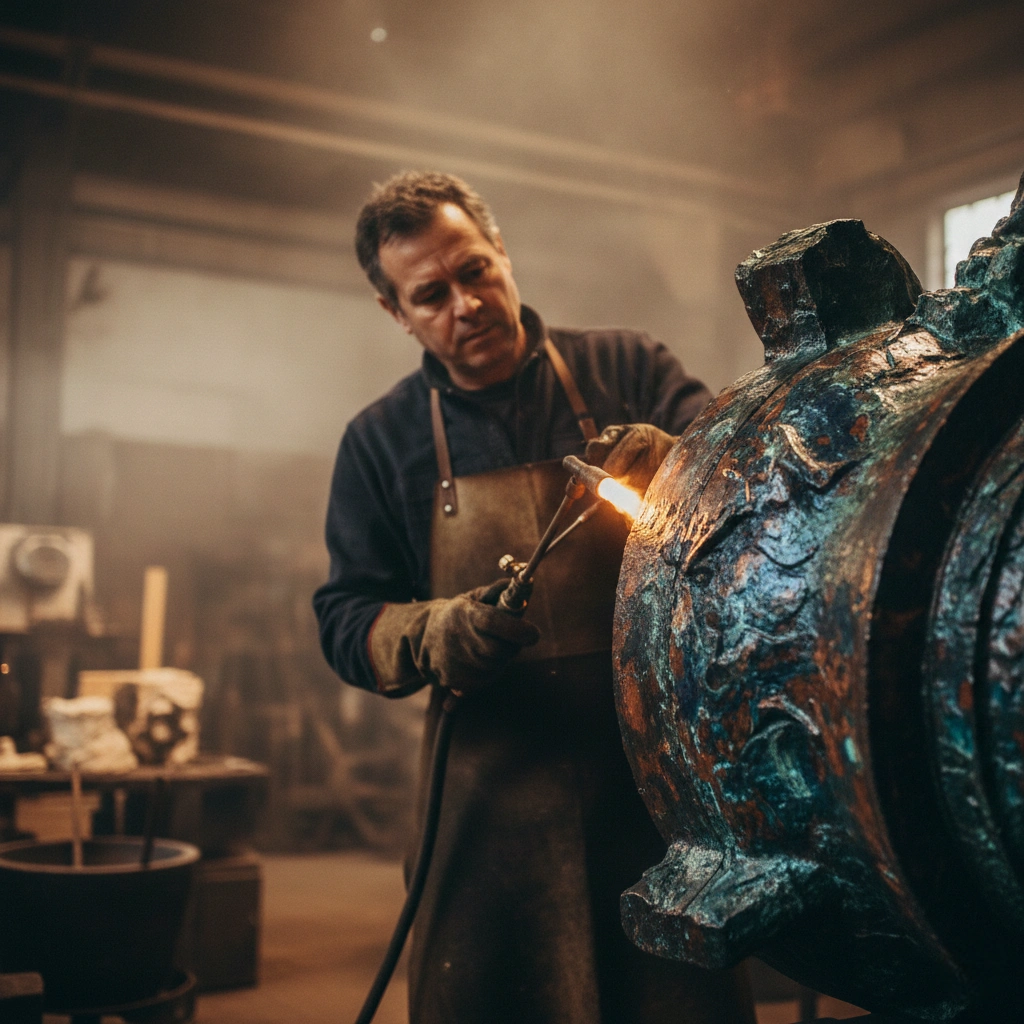
Bronze has been the material of choice for important outdoor sculptures and fountains for over 5,000 years — from the ritual vessels of Bronze Age civilizations to the monumental fountains of Baroque Europe to the contemporary water features of luxury hospitality developments worldwide. The reasons for this enduring preference are rooted in bronze’s unique combination of castability, durability, and the living patina surface that develops with age.
At Shushin Art’s bronze foundry in Quyang, we have operated a fully integrated lost-wax casting facility for over three decades, producing bronze fountains for landscape architects, hotel developers, and municipal clients on six continents. This guide covers the fabrication process, finish options, sizing considerations, and specification requirements that every buyer should understand before commissioning a bronze fountain.
The Lost-Wax Casting Process: Why It Produces Superior Bronze Fountains
Not all bronze casting produces equal results. The lost-wax (cire perdue) casting process — used for the finest bronze sculptures since ancient Egypt — produces a level of surface fidelity and thin-section capability that sand casting cannot match. For fountains with complex sculptural elements, flowing water channels, and intricate bas-relief decoration, lost-wax casting is the only process that consistently delivers the required quality.
Investment Casting vs. Sand Casting
Investment (lost-wax) casting involves creating a detailed wax model of the fountain, coating it in a ceramic investment, melting out the wax, and pouring molten bronze into the resulting cavity. The process permits wall sections as thin as 3mm in non-structural areas while maintaining the ability to cast sections over 50mm thick where required for structural integrity.
Sand casting — the lower-cost alternative — forces molten bronze into a mold made from compacted sand. While adequate for simple geometric forms, sand casting produces a significantly coarser surface texture that requires extensive chasing (hand-finishing) to approach the quality of an investment-cast piece. For fountains with complex organic forms, sand casting produces unacceptable surface pitting and cold shuts at section changes.
Every fountain element at Shushin Art is produced using the lost-wax process. We do not offer sand-cast bronze fountains, as we believe the quality gap is irreconcilable for the applications our clients specify.
The Multi-Pour Process for Large Fountains
Fountains exceeding 2 meters in any dimension typically cannot be cast in a single pour due to bronze’s thermal contraction during solidification (approximately 2.2% linear shrinkage). Our foundry team uses a ceramic core assembly method that allows sequential section pours with precision alignment references built into the mold, ensuring that the assembled fountain shows no visible seams at the joint lines.
For tiered fountains, we typically cast each tier as a separate piece, with internal bronze or stainless steel armature connecting the assembly. The tier junction points are designed to be concealed within the fountain’s natural shadow lines, typically at the rim junction of each tier.
Bronze Alloy Specifications: What “Silicon Bronze” Actually Means
The bronze alloy specified for a fountain determines its casting characteristics, mechanical properties, surface appearance, and long-term corrosion resistance. Not all bronze alloys are equal for outdoor fountain applications.
Our Standard Alloy: CuSi8P (Silicon Bronze)
Shushin Art specifies CuSi8P (approximately 8% silicon, 0.5% manganese, remainder copper) as our standard fountain alloy. This alloy offers the best combination of castability, mechanical strength, and corrosion resistance for outdoor water feature applications. Silicon bronze develops a stable oxide patina that resists further corrosion even in marine environments, making it our standard recommendation for coastal installations.
Gunmetal (88-10-2) for Hydraulic Components
The submerged pump housing, inlet strainers, and pipe fittings within a bronze fountain’s hydraulic system are specified in gunmetal (88% copper, 10% tin, 2% zinc) rather than silicon bronze. Gunmetal offers superior resistance to dezincification corrosion in fresh water — the failure mode that most commonly affects pump housings in incorrectly specified bronze fountains.
We specify gunmetal for all submerged hydraulic components as standard. This is an item that many lower-cost bronze foundries skip to reduce cost, resulting in premature pump housing failure within 5-8 years of installation.
Nickel Silver for Marine Environments
For fountain installations within 500 meters of saltwater, we recommend specifying our nickel silver alloy (copper-nickel-silicon) which offers superior resistance to chloride-induced stress corrosion cracking. The premium over standard silicon bronze is approximately 15-20%, but it eliminates a significant risk category for coastal installations.
Patina Finishes: From Standard Brown to Custom Color Development
The surface finish of a bronze fountain is both aesthetic and functional. The chemical patina applied to the surface develops through controlled oxidation, and the specific formulation determines both the color palette and the stability of the surface.
Standard Brown and Black Patinas
Our standard finish for outdoor bronze fountains is a two-stage ferric nitrate patina that develops a rich medium-brown color with warm undertones. Applied by torch to the heated bronze surface (150-200 degrees Celsius), this finish penetrates the surface to a depth of approximately 0.3mm and develops naturally over the first 2-3 years of outdoor exposure to a depth and complexity that factory application cannot fully replicate.
After patina application, all surfaces are sealed with a penetrating wax compound (Renaissance Wax) that provides temporary protection during shipping and installation. We recommend re-sealing with a wax compound every 12-18 months as part of routine maintenance.
Verde Antigua (Natural Green Patina)
The iconic verde antique green patina associated with aged bronze is achieved using a cupric nitrate-based patina. This finish takes significantly longer to develop naturally (10-20 years) but can be chemically accelerated to achieve a stable 3-5 year natural appearance within the first season of outdoor exposure. Verde antique is our most requested premium finish, particularly for classical fountain designs and heritage restoration projects.
Custom Patina Specifications
We accept custom patina specifications including two-tone finishes (contrasting patina in recessed areas), painted surfaces with clear overcoat, and gilding of specific sculptural details. Custom patina work requires an additional design consultation and is priced on a project-specific basis.
Sizing and Design Considerations for Bronze Fountains
Bronze fountains present unique sizing and design challenges compared to stone alternatives, primarily due to the material’s strength-to-weight ratio and the integration requirements with recirculating hydraulic systems.
Tabletop and Small Fountains (Under 0.5 Meters)
Small bronze fountains — ranging from desktop-scale pieces to those occupying a patio table or small garden niche — are the most technically straightforward to specify. At this scale, the recirculating pump can be concealed within the fountain’s base, eliminating above-ground plumbing. Pump options at this scale range from 200-800 liters per hour, drawing 15-50 watts.
Small bronze fountains are also the most appropriate entry point for clients who have not previously commissioned cast bronze. Our standard small fountain catalog includes twelve distinct designs in heights ranging from 300mm to 500mm, available for shipment within 6-8 weeks of order confirmation.
Pedestal and Floor Fountains (0.5-2.5 Meters)
The mid-range is the most technically diverse category for bronze fountains, encompassing single-tier and multi-tier pedestal designs, wall-mounted fountains, and basin designs with integrated sculptural elements. At this scale, the recirculating pump must be mounted below grade — typically in a concrete or HDPE basin chamber — and fed through concealed supply piping.
For pedestal fountains in the 1-2.5 meter range, we recommend a dedicated concrete basin with a minimum 50mm thick walls, fully waterproofed with a crystalline integral waterproofing additive. Basin sizing should provide a minimum 2:1 ratio of basin capacity to pump flow rate to prevent air entrainment and pump cavitation.
Monumental Fountains (Above 2.5 Meters)
Monumental bronze fountains — standing 2.5 meters and above — require the same engineering rigor applied to structural steel and reinforced concrete. Internal armature must be engineered by a qualified structural engineer to withstand wind loads, seismic forces, and the dynamic loads from circulating water. We provide structural engineering calculations and drawings for all monumental fountain commissions.
Installation Requirements and Site Coordination
Bronze fountains above 500mm require site preparation beyond standard landscape work. The combination of high point loading, concealed hydraulics, and electrical supply creates coordination requirements that should be addressed during the design development phase, not discovered during construction administration.
Foundation and Structural Requirements
A 2-meter tiered bronze fountain with a full water load can exceed 12,000 kg in total mass. This requires a cast-in-place concrete foundation with minimum 32 MPa compressive strength, designed by a structural engineer familiar with the site soil conditions. We provide foundation loading drawings specifying dimensions, reinforcement, and concrete specification.
Hydraulic System Installation
The recirculating pump system requires coordination between the fountain contractor, an electrical contractor familiar with NEC Article 680 (swimming pool and fountain electrical requirements), and a plumber who understands the specific requirements of recirculating water feature systems. We provide a detailed hydraulic schematic with every fountain that specifies pump model, pipe routing, flow control valve locations, and overflow drain connections.
Frequently Asked Questions
How long does a bronze fountain last outdoors?
A properly specified and maintained bronze fountain will outlast any structure around it. The earliest cast bronze artifacts from the Shang Dynasty (c. 1600-1046 BCE) remain in excellent condition after over 3,000 years. For modern bronze fountains, a service life of 100+ years is entirely realistic with routine maintenance (annual wax sealing, pump servicing, and inspection of joint integrity).
What causes green spotting on a bronze fountain?
Green spotting — known as bronze disease or “applying” — is a localized chloride-induced corrosion that appears as bright green powdery spots on the patina surface. It indicates a breakdown in the patina’s protective function, typically caused by pooling water, bird contact with saline residue, or proximity to saltwater air. If detected early, bronze disease can be treated by a conservator; if left untreated, it will progressively degrade the surface. Prevention through correct patina specification and regular maintenance is significantly more cost-effective than remediation.
Can a bronze fountain be moved after installation?
Bronze fountains can be relocated, but the process requires careful planning. For fountains above 500kg, we recommend engaging a specialist sculpture rigging company. We can provide rigging drawings showing lift points, center of gravity, and estimated weight distribution to assist the rigging contractor. All fountains above 1.5 meters are designed with internal lifting eyes as standard.
How often should the pump be serviced?
We recommend annual pump servicing, which involves removing the pump from the basin, disassembling the impeller assembly, cleaning the impeller vanes and housing, and replacing the shaft seals. Pump seal replacement is required every 3-5 years depending on water hardness and operating hours. We include a complete pump service kit with every fountain shipment.
Do you offer warranty on bronze fountains?
We provide a 10-year structural warranty covering casting defects and armature failure. The warranty does not cover damage from improper installation, failure to maintain the patina sealer, freeze-thaw damage in inadequately winterized installations, or damage from corrosive environmental conditions beyond the alloy’s specification. Full warranty terms are provided with the project proposal.
What payment terms do you offer for international orders?
For first orders, we require a 40% deposit to commence fabrication and the balance prior to shipment. For established clients and orders above USD 50,000, we offer L/C at sight payment terms through approved banks. All quotes are valid for 60 days from the date of issue.
Related Resources for B2B Buyers
- Custom Bronze Sculptures — Full-service lost-wax bronze fabrication for commercial and municipal projects
- Browse Bronze Sculpture Portfolio — View our complete bronze fountain, figure, and animal collection
- Bronze Fountain Collection — Standard designs ready for customization and fast shipment
- Custom Marble Sculptures — Marble alternatives for clients comparing stone and bronze fountain options
- Custom Stainless Steel Sculptures — Modern alternatives to bronze for contemporary landscape settings
- About Shushin Art — Our foundry history, certifications, and export capabilities
- Factory Tour — Tour our lost-wax foundry and bronze casting facilities in Quyang, China
- Request a Custom Bronze Fountain Quote — Submit your project specifications for a detailed proposal within 24 hours