
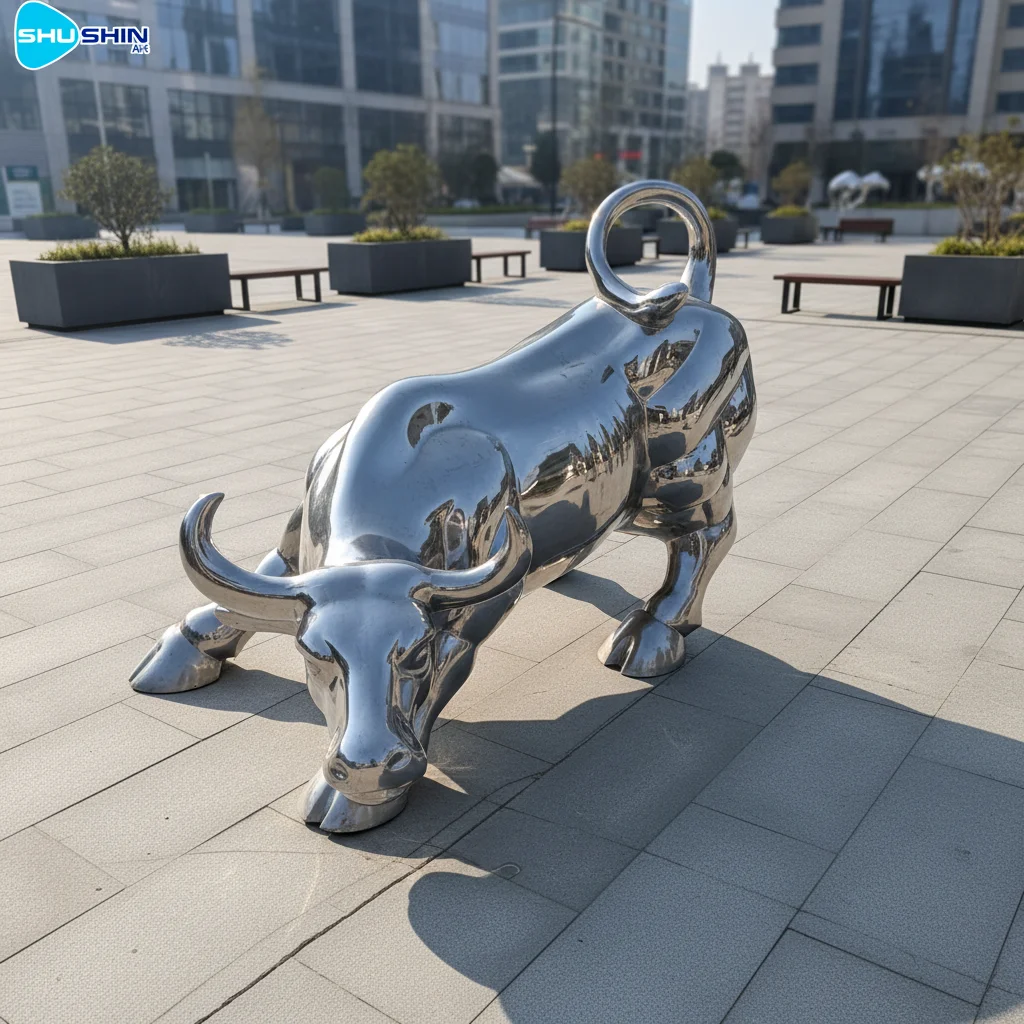
Stainless steel has become the defining material of contemporary public sculpture — from the monumental abstract forms of Anish Kapoor to the sleek corporate installations of tomorrow’s urban developments. Its appeal for architectural sculpture is straightforward: it is strong enough to be engineered for monumental scale, corrosion-resistant enough for permanent outdoor installation in any climate, and its mirror-polished surface reflects and transforms its surroundings in ways no other material can replicate.
At Shushin Art, our stainless steel fabrication division combines precision engineering with sculptural craft, producing custom stainless steel sculptures for architects, landscape architects, urban developers, and art consultants worldwide. This guide covers the key engineering and aesthetic decisions that drive every stainless steel sculpture commission.
Material Selection: 304 vs. 316L for Outdoor Sculpture
The choice between 304 and 316L stainless steel is the first and most consequential specification decision for any outdoor stainless steel sculpture. The wrong choice for the environment will lead to surface staining, pitting, and ultimately corrosion within 5-15 years — far short of the 50+ year service life that a properly specified stainless steel sculpture should achieve.
304 Stainless Steel: Standard Indoor and Low-Humidity Outdoor
304 stainless steel (18/8: 18% chromium, 8% nickel) is the most widely used stainless alloy in architectural applications. It offers excellent corrosion resistance in dry environments and adequate resistance in normal outdoor conditions. For sculptures installed in arid climates, fully sheltered outdoor locations, and all indoor applications, 304 is the cost-effective choice.
316L Marine-Grade: Our Standard Recommendation
316L stainless steel (18/10/2: 18% chromium, 10% nickel, 2% molybdenum) adds molybdenum to the 304 formula, providing significantly improved resistance to chloride-induced pitting and crevice corrosion. 316L is the correct specification for any outdoor installation within 10 kilometers of a coastline, in areas with significant air pollution, in humid tropical or subtropical climates, and for sculptures that will be in contact with recirculating water.
Shushin Art specifies 316L as our standard alloy for all outdoor stainless steel sculptures — the material cost premium of approximately 15% over 304 is negligible against the risk of a corrosion failure that requires costly re-polishing or replacement. We recommend this specification without exception for all outdoor commissions.
Surface Finish: The Spectrum from Satin to Mirror Polish
The surface finish of a stainless steel sculpture is not merely aesthetic — it determines how the sculpture interacts with light and its surroundings, and how it weathers over time. Each finish also has different maintenance requirements and different manufacturing costs.
Mirror Polish (No. 8 Finish)
The mirror polish is the highest-reflectivity finish achievable on stainless steel — it can reach 95%+ reflectivity when new, creating a surface that functions as a convex mirror, reflecting its surroundings with dramatic distortion. This is the finish most associated with contemporary abstract sculpture and corporate installations.
Achieving a true mirror polish requires multiple stages of progressive abrasive polishing, from initial grinding through increasingly fine compounds, ending with a chrome oxide rouge stage. Our polishing team requires an average of 3-5 days per square meter of surface to achieve a true No. 8 mirror finish. The cost is substantial but so is the result.
Satin and Brushed Finishes
A satin (No. 4 brush) finish creates a uniformly directional grain texture that reduces reflectivity to approximately 60-70% while hiding minor surface scratches better than mirror polish. Satin finishes are preferred for sculptures in high-traffic public areas and for contemporary minimalist designs where a softer, less confrontational surface is desired.
PVD Color Coatings
Physical Vapor Deposition (PVD) coating allows stainless steel sculptures to be produced in a range of surface colors — gold, rose gold, black, blue, and custom colors — while retaining the durability and corrosion resistance of the stainless steel substrate. PVD coatings are harder and more durable than paint, with a 20-30 year service life in outdoor conditions. This is increasingly specified for corporate identity installations and hospitality projects where branding colors are required.
Structural Engineering for Large-Scale Steel Sculpture
Stainless steel’s high strength-to-weight ratio enables sculptural forms that would be impossible in stone or cast metal, but this capability must be matched by engineering precision. A large stainless steel sculpture is a structure as much as it is a sculpture — and it must be engineered to survive wind loads, seismic forces, and the dynamic loads from any interactive elements for its full design service life.
Internal Armature and Weld Design
All stainless steel sculptures above 1.5 meters are engineered with internal structural armature in addition to the outer aesthetic shell. The armature design — including material selection, member sizing, weld specifications, and connection details — is produced by our structural engineer using finite element analysis (FEA) to verify structural adequacy under design loads.
All structural welds on our sculptures are made by certified stainless steel welders (AWS D1.6 qualified), using matching filler metals and following approved weld procedures. The structural integrity of all critical weld joints is verified by magnetic particle inspection (MPI) or liquid penetrant inspection (LPT).
Foundation and Mounting Engineering
For sculptures installed on grade or on building structures, we provide foundation loading drawings specifying the concrete pier or structural steel mounting frame required to support the sculpture’s weight and transfer design loads safely to the underlying structure. These drawings are coordinated with the project structural engineer during the construction documentation phase.
Custom Design Process
Our custom stainless steel sculpture process begins with a design brief from the client — ideally including concept sketches, reference images, site photographs, and a written description of the intended meaning and character of the sculpture. Our design team translates this brief into concept drawings and a 3D concept model (rendered in key lighting conditions) for client review.
For commissions above USD 30,000, we produce a 1:10 scale prototype in stainless steel for physical review. The prototype is produced in the same material, finish, and fabrication methods as the full-scale sculpture, allowing the client to evaluate the surface quality and structural proportions before full fabrication commences.
Frequently Asked Questions
What is the typical price range for a custom stainless steel sculpture?
Custom stainless steel sculptures range from USD 8,000 for small-scale (under 1 meter) pieces to USD 500,000+ for monumental commissions. Most commercial and residential commissions fall in the USD 15,000-80,000 range. A meaningful quote requires concept drawings and size specifications.
How long does a custom stainless steel sculpture take?
From design approval to delivery: small sculptures (under 1m) 6-12 weeks; medium sculptures (1-3m) 10-20 weeks; large and monumental sculptures (above 3m) 16-32 weeks. Fabrication time is primarily driven by the complexity of the form and the surface finish specification.
Does stainless steel sculpture require maintenance?
One of the advantages of stainless steel is its low maintenance requirement. In normal outdoor environments, periodic cleaning with fresh water (every 6-12 months) is sufficient to maintain the surface appearance. In coastal or industrial environments, more frequent cleaning may be required. We provide a maintenance specification document with every sculpture.
Can stainless steel sculptures be illuminated?
Yes. We frequently integrate LED lighting systems into stainless steel sculptures, using the mirrored surface to amplify and distribute light. Lighting integration requires coordination during the design phase to conceal wiring and fixture housings within the sculpture’s structure.
Related Resources
- Custom Stainless Steel Sculptures — Our full steel fabrication capabilities
- Stainless Steel Sculpture Portfolio — View our catalog of standard and modified-standard designs
- Abstract Steel Sculptures — Contemporary abstract forms in mirror-polished steel
- Custom Marble Sculptures — Natural stone alternatives for traditional settings
- Request a Custom Steel Sculpture Quote — Submit your project for a detailed proposal