
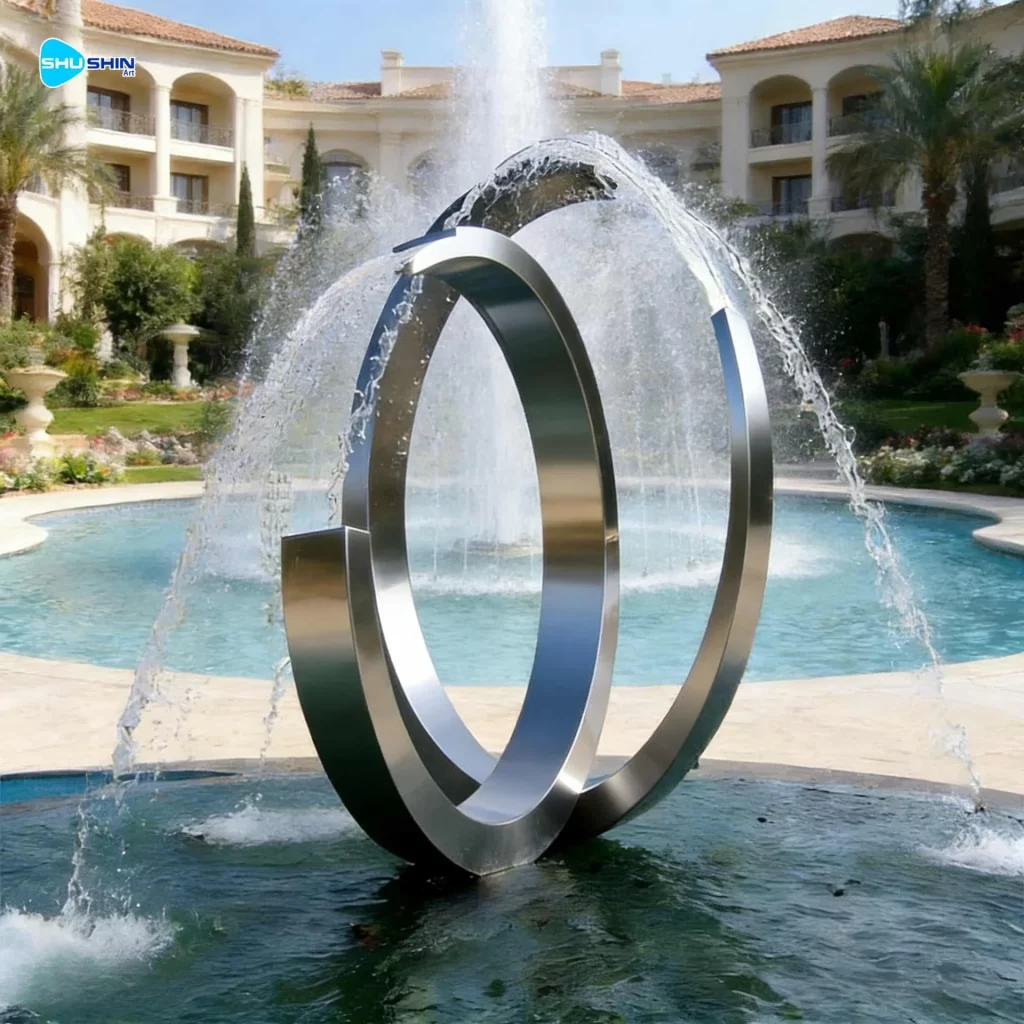
The fountain decisions you make at the schematic design stage will follow your project for decades. Material selection, basin sizing, water circulation design, and pump specification are all locked in once construction begins — and changing any of them after installation is expensive, disruptive, and sometimes impossible.
This guide is written for landscape architects and project designers who need to make these decisions early, with enough technical knowledge to specify correctly and enough practical awareness to avoid the common mistakes that create maintenance headaches and budget overruns.
Material Selection: Stone vs. Bronze for Fountain Sculpture
The choice between stone and bronze for fountain sculpture is not primarily aesthetic — it is structural, hydraulic, and maintenance-driven. Each material has specific properties that make it more or less suitable for different fountain applications.
Stone Fountains: Marble and Granite
Stone fountain sculpture offers visual weight, permanence, and a material character that complements classical and contemporary landscape designs. The two primary stone options for fountain work are marble and granite, each with distinct performance characteristics.
Marble provides exceptional surface detail and a luminous quality when wet — the water film on polished marble creates a depth of color that dry marble cannot achieve. However, marble is softer (Mohs 3-4) and more porous than granite, making it susceptible to erosion in high-flow applications and staining in mineral-rich water environments.
For marble fountain sculpture, we recommend limiting water flow across carved surfaces to low-volume sheets or drips rather than high-pressure jets. This preserves surface detail and reduces maintenance requirements. Marble is best suited for: reflecting pools, gentle cascades, and sculptural elements where water interacts with the surface as a design feature rather than a structural load.
Granite provides superior hardness (Mohs 6-7), lower porosity, and exceptional resistance to freeze-thaw cycling. Granite fountain sculpture can withstand high-flow applications, aggressive water treatment chemicals, and decades of outdoor exposure with minimal maintenance.
The visual character of granite is different from marble — less luminous, more substantial, with a surface texture that reads as architectural rather than sculptural. Granite is best suited for: high-flow fountains, public plazas, urban installations, and any application where durability is the primary concern.
Bronze Fountains: The Versatile Option
Bronze fountain sculpture offers unique advantages that neither stone material can match: the ability to integrate water delivery directly into the sculpture, the durability of metal in constant water contact, and the patina development that creates a living surface evolving over years of exposure.
Bronze is the material of choice for: figurative fountain sculpture (where water emerges from the figure’s hands, mouth, or attributes), interactive water features (where visitors touch or walk through the water), and any design where the sculpture and water system must function as an integrated unit.
The primary consideration for bronze in fountain applications is the patina. Bronze in constant water contact develops a distinctive green patina (verdigris) that many designers find attractive — but it must be anticipated and embraced rather than fought. Applying lacquer or wax to bronze in fountain service creates maintenance burden without long-term benefit, as the protective coating will fail within 1-3 years in constant water contact.
Scale and Proportion: Getting the Size Right
Fountain sculpture must be proportioned correctly relative to the basin, the surrounding landscape, and the viewing distance. A sculpture that is too small for its basin looks lost; one that is too large overwhelms the water feature and creates hydraulic problems.
The Basin-to-Sculpture Ratio
For reflecting pools and still-water basins, the sculpture should occupy 25-40% of the basin surface area when viewed from the primary viewing angle. This provides sufficient water surface to create reflections while maintaining the sculpture as the visual focal point.
For active fountains with water movement, the basin should be 2-3 times the sculpture footprint to accommodate splash zones, water circulation patterns, and maintenance access. Undersized basins create splash problems, water loss, and slippery surfaces that create liability concerns.
Viewing Distance and Height
The relationship between sculpture height and primary viewing distance determines visual impact. For a sculpture viewed from 10 meters, the optimal height range is 1.5-2.5 meters — tall enough to command attention, proportionate to the viewing distance, and scaled to the surrounding landscape elements.
For sculptures viewed from greater distances (20-50 meters, typical of hotel arrival sequences or corporate campus entries), heights of 3-5 meters are appropriate. Below this range, the sculpture loses visual presence at distance; above this range, the scale begins to dominate the landscape inappropriately.
Water System Design: The Technical Foundation
The water system is the mechanical heart of any fountain. Design decisions made at the schematic stage determine operating costs, maintenance requirements, and long-term reliability.
Circulation System Types
Recirculating systems are the standard for most fountain applications. Water is collected in a basin, filtered, treated, and recirculated through the fountain. Recirculating systems minimize water consumption (typically 5-10% makeup water per week to replace evaporation and splash loss) and allow precise control of water quality.
Flow-through systems use a continuous supply of fresh water, with the spent water draining to waste or irrigation. Flow-through systems are simpler to maintain but consume significantly more water and are typically limited to small decorative features or areas where water conservation is not a priority.
Pump Sizing
Pump capacity is specified in gallons per minute (GPM) or liters per minute (LPM), and must be matched to the fountain’s hydraulic requirements — the total dynamic head (vertical lift plus friction losses) and the desired flow rate at each water outlet.
Undersized pumps produce weak, disappointing water effects. Oversized pumps waste energy, create excessive splash, and can damage sculpture surfaces through hydraulic erosion. The correct pump size is determined by hydraulic calculation, not guesswork.
Filtration and Water Treatment
Recirculating fountain systems require filtration to remove debris and water treatment to prevent algae growth, mineral scaling, and corrosion. The filtration system specification depends on the fountain’s water volume, the surrounding landscape (which determines debris load), and the water treatment approach.
For most commercial fountain installations, we recommend sand filtration with automated chemical treatment. This combination provides reliable water quality with minimal operator intervention — important for fountains that are not attended full-time.
Climate Considerations: Designing for Your Environment
Fountain design must account for local climate conditions that affect both the sculpture material and the water system operation.
Freeze-Thaw Environments
In climates with freezing temperatures, fountain design must address winterization — the process of protecting the fountain from freeze damage during cold months. This typically involves draining the basin and water lines, installing freeze protection for underground components, and selecting sculpture materials that resist freeze-thaw damage.
Granite and bronze are the preferred materials for freeze-thaw environments. Marble is acceptable with proper sealing and drainage design, but requires more maintenance attention in cold climates.
Hot-Arid Environments
In hot, dry climates, evaporation rates can exceed 2-3 inches per week — significantly increasing water consumption and operating costs. Fountain design for arid environments should minimize exposed water surface area, incorporate wind baffles to reduce evaporation, and consider closed-loop water systems that minimize evaporation losses.
Frequently Asked Questions
What is the best material for an outdoor fountain?
For most outdoor fountain applications, granite and bronze are the most durable options. Granite provides superior hardness and freeze-thaw resistance; bronze allows integrated water delivery and develops an attractive patina. Marble is suitable for low-flow applications in moderate climates where its luminous quality is desired.
How much does a custom fountain sculpture cost?
Custom fountain sculpture pricing depends on material, size, and water system complexity. A small marble fountain (60-80cm) with basic water system starts at $3,000-$8,000. A life-size bronze fountain figure with integrated water delivery ranges from $15,000-$40,000. Large-scale fountain installations with custom basins and advanced water systems can range from $50,000-$200,000+.
How long do fountain sculptures last?
With proper material selection and maintenance, fountain sculptures last decades to centuries. Bronze fountain figures in European public squares have survived 300+ years of continuous water service. Granite fountain elements are essentially permanent. Marble requires more maintenance but can last centuries with proper care.
What maintenance do fountains require?
Regular fountain maintenance includes: weekly water quality testing and chemical adjustment, monthly filter cleaning, quarterly pump inspection, and annual sculpture cleaning and material assessment. The maintenance burden varies significantly with material selection — bronze and granite require less maintenance than marble in fountain service.
Related Resources
- Marble Fountain Collection — Standard fountain designs ready for customization
- Bronze Fountain Collection — Cast bronze fountain sculptures
- Custom Bronze Sculptures — Our lost-wax bronze foundry capabilities
- Custom Marble Sculptures — Our marble carving capabilities
- Request a Fountain Consultation — Submit your project for a design review